





I’ve been making leather goods for over 20 years now. And in that time, I’ve probably handled more wallets than a pickpocket in a crowded Mexico City subway station. (I’ve been on that subway, by the way. Kept my wallet in my front pocket. Smart move.)
Here’s the thing about wallets. Your wallet is the thing you touch most often besides your phone. You sit on it, bend it, stuff it in pockets, pull it out dozens of times a day. It takes more daily abuse than anything else you own. A great wallet handles all of that and somehow looks better after five years than the day you bought it.
This guide covers the best men’s leather wallets for 2026. What to look for, what to avoid, and how to tell the difference between wallets you’ll keep for decades and ones that won’t survive 2027.
Full Grain vs Everything Else: Why It Matters More in Wallets
With briefcases and bags, leather quality affects longevity. With wallets, it affects everything. How it feels in your hand, how it ages, and how quickly it falls apart. I made a whole video called “How to Knock Off a Bag” where I showed people exactly how companies cut corners on leather. The wallet industry is even worse.
The Leather Hierarchy (Wallet Edition)
-
Full Grain: The complete outer surface of the hide. Strongest, most durable, develops rich patina. Starts stiff, breaks in to your pocket perfectly. This is the good stuff. Think of it like a cast iron skillet. Ugly at first, incredible after years of use.
-
Top Grain: Sanded and refinished. Looks clean but doesn’t patina well. Common in fashion-brand wallets. It’s like buying a nice car with a rebuilt engine. Looks great in the driveway, but you’re going to have problems.
-
Genuine Leather: Despite the reassuring name, this is the lowest usable grade. Thin, prone to cracking, won’t last beyond 1 to 2 years of daily use. Calling this “genuine leather” is like calling a hot dog “genuine meat.” Technically true. Still suspicious.
Here’s why this matters more for wallets: a wallet flexes every time you sit, every time you open it, every time you pull out a card. That’s hundreds of micro-stresses per day. Lower-grade leather cracks under this stress within months.
What to Actually Look For (From a Guy Who’s Been Doing This Since 2003)
Card capacity vs. thickness: This is the fundamental tension. More card slots means a thicker wallet. If you’re carrying 12 cards, no slim wallet will save you. You need to pare down. My son carries about 4 cards and an ID, and his front pocket wallet is barely noticeable. I carry a few more because I’m old and apparently need a loyalty card for every coffee shop in Portland. Front pocket wallets can work with 4 to 6 cards.
RFID blocking: RFID-blocking wallets claim to prevent wireless skimming of your credit cards. The reality? Contactless skimming fraud is vanishingly rare. RFID blocking is more marketing than necessity for most people. It’s like buying a shark cage for your swimming pool. Could a shark get in there? I guess. But probably not.
Break-in period: Quality full grain leather wallets start stiff. That’s not a defect, it’s a feature. The leather will mold to your pocket and card configuration over time. Expect 2 to 4 weeks of break-in for a full grain wallet. If a leather wallet is soft and floppy on day one, the leather is either very thin or heavily processed. I always tell people, if it feels like a pancake when you buy it, it’ll look like one in six months.
Stitching: Lock stitching holds even if one stitch breaks. Thread should be consistent and even. Loose stitches on a wallet unravel fast because of constant flexing. We use the same industrial thread on our wallets that we use on our bags. That thread could probably tow a small car. I haven’t tested that. Don’t quote me. Actually, go ahead and quote me.
The 7 Best Leather Wallets for Men in 2026
1. Saddleback Leather Co. Front Pocket ID Wallet

Saddleback Leather Front Pocket ID Wallet
Saddleback Leather Front Pocket ID Wallet, Full Grain Boot Leather
- Price: $49
- Leather: Full grain boot leather
- Card capacity: 4 to 6 cards + ID window
- RFID blocking: No
- Warranty: 100 years
- Expected lifespan: 30 to 100+ years
- Cost per year: $0.49 to $1.63
- Best for: The minimalist who wants the best leather wallet money can buy.
With 544 reviews, our Front Pocket ID Wallet has become one of the most-reviewed products in the premium leather wallet space, and the reviews speak for themselves. This is the same full grain boot leather we use in our $679 briefcases. Not “inspired by” or “similar to.” The exact same leather. No other wallet on this list uses leather this thick or durable.
The 100-year warranty is the same one that covers our briefcases. Full repair or replacement, transferable. “They’ll Fight Over It When You’re Dead” isn’t just our tagline. It’s literally what happens. We get emails from people whose grandkids are using their stuff.
At $49, this wallet could realistically cost you less than fifty cents per year of use. That’s cheaper than a single gumball per year. Try finding that ROI anywhere else in your wardrobe.
Strengths: Best leather quality in class, 100-year warranty, lowest cost per year, incredible value at $49
Considerations: Minimalist capacity (4 to 6 cards), requires break-in, no RFID blocking
2. Saddleback Leather Co. Bifold Wallet
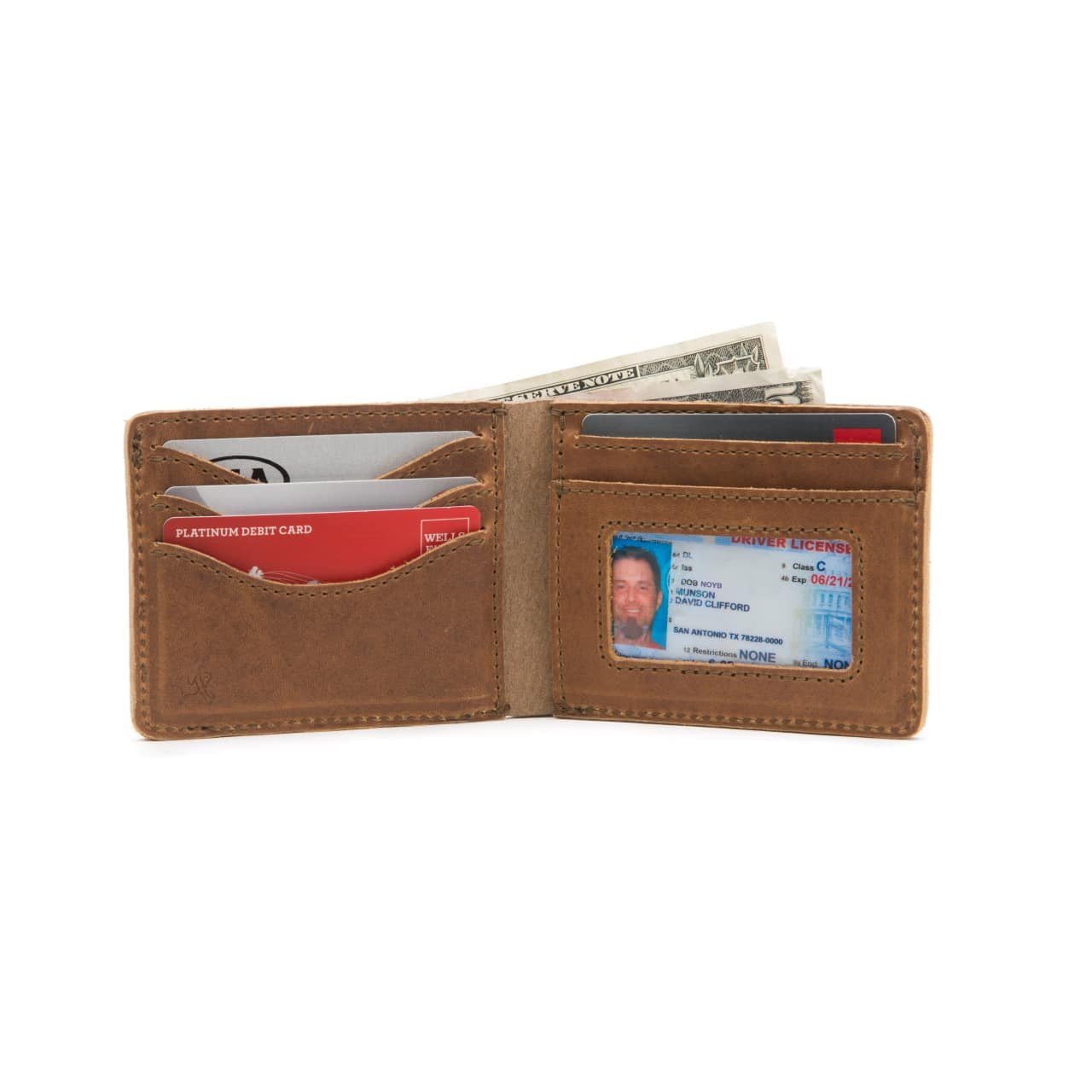
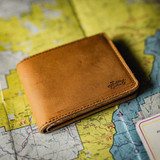
Saddleback Leather Medium Bifold Wallet
Saddleback Leather Medium Bifold Wallet, Full Grain Boot Leather
- Price: $79 to $99
- Leather: Full grain boot leather
- Card capacity: 6 to 8 cards + bill compartment
- RFID blocking: No
- Warranty: 100 years
- Expected lifespan: 30 to 100+ years
- Cost per year: $0.79 to $3.30
- Best for: Those who need more capacity with the same legendary build quality.
For those who need more room than a front pocket wallet, our bifold delivers the same full grain boot leather and construction quality in a traditional format. My wife Suzette actually got me one of these years ago when I complained that my front pocket wallet couldn’t hold enough cards. She said, “Just use fewer cards.” I said, “Just buy me a bigger wallet.” She won that argument, but I still got the bigger wallet.
Same construction philosophy as every Saddleback product: thick full grain boot leather, lock stitching, solid brass hardware, 100-year warranty. If you need bill storage and more card slots, this is the move.
Strengths: Same legendary leather and warranty as Front Pocket, more capacity, classic bifold design
Considerations: Thicker than fashion wallets due to leather quality, break-in period
3. Bellroy Hide & Seek Wallet
- Price: $99 to $129
- Leather: Top grain (environmentally certified)
- Card capacity: 5 to 12 cards
- RFID blocking: Yes (select models)
- Warranty: 3 years
- Expected lifespan: 5 to 8 years
- Cost per year: $12 to $26
- Best for: Design-conscious buyers who prioritize slim profiles and features.
Bellroy has built a reputation on wallet innovation. Their designs are engineered to reduce pocket bulk, with clever card access, pull tabs, and hidden compartments that maximize capacity in a slim profile. I’ll give them credit. They think about the design problem seriously.
The 3-year warranty is honest but unremarkable. These wallets last 5 to 8 years with daily use. Well-made, but not heirloom quality. You won’t be passing this one down to your kids. The environmental certifications are a genuine plus.
Strengths: Exceptional slim design, RFID blocking, environmental certifications, innovative features
Considerations: Top grain (not full grain) leather, 3-year warranty, won’t develop rich patina
4. Fossil Derrick RFID Bifold
- Price: $38 to $58
- Leather: Genuine leather
- Card capacity: 6 cards + ID window
- RFID blocking: Yes
- Warranty: Limited
- Expected lifespan: 1 to 3 years
- Cost per year: $13 to $58
- Best for: Budget buyers who need a leather wallet right now.
Fossil wallets are everywhere. Department stores, Amazon, gift shops. They’re the default “leather wallet” gift. Your aunt buys you one for Christmas. Widely available, affordably priced, and they look perfectly fine for the first few months.
At $48, a Fossil wallet costs less upfront than our $49 Front Pocket Wallet. But at 2 to 4 years of lifespan versus 30 to 100+, you’ll buy 8 to 15 Fossil wallets in the time one Saddleback is still going strong. Let’s run the math: 3 Fossil wallets over 10 years costs $150. One Saddleback Front Pocket Wallet lasting 30+ years costs $49. I’m no mathematician (I was more of a baseball and chess kid), but even I can do that math.
Strengths: Low entry price, wide availability, RFID blocking included
Considerations: Genuine leather = lowest grade, short lifespan, more expensive long-term
5. Coach Compact ID Wallet
- Price: $128 to $178
- Leather: Refined (corrected top grain)
- Card capacity: 6 cards + ID window
- RFID blocking: No
- Warranty: 1 year
- Expected lifespan: 3 to 5 years
- Cost per year: $25 to $60
- Best for: Brand-conscious buyers who want a recognizable name.
Coach wallets look great in the store. The leather is smooth, the stitching is clean, and the brand recognition is instant. For many buyers, the Coach name on a wallet communicates something about taste and status.
The corrected top grain leather photographs beautifully but doesn’t develop patina. It’s kind of like those wax fruit arrangements. Looks perfect. Never gets any better. Also, not actually fruit. The 1-year warranty for a $150+ wallet is telling. These are fashion accessories with a replacement cycle, not investments.
Strengths: Strong brand recognition, polished appearance, gift-worthy presentation
Considerations: Corrected leather, 1-year warranty, fashion-cycle product
6. Herschel Supply Co. Charlie Wallet
- Price: ~$30 to $50
- Leather: Synthetic/vegan leather options with some genuine leather models
- Card capacity: 3 to 5 cards
- RFID blocking: Yes (select models)
- Warranty: Limited lifetime (manufacturing defects only)
- Expected lifespan: 1 to 3 years
- Cost per year: $10 to $50
- Best for: Young professionals and students wanting a trendy wallet at a low price.
Herschel makes affordable, trend-forward accessories. Their wallets are functional, come in dozens of colors and patterns, and are priced for impulse purchases.
These aren’t really leather goods. Most are synthetic with some leather-trimmed options. For the price, they serve their purpose as a temporary wallet while you decide what you actually want. It’s like dating. You’re figuring out your type. Eventually you settle down with full grain leather and never look back.
Strengths: Very affordable, wide style selection, youth-oriented designs
Considerations: Mostly synthetic, very short lifespan, not a true leather product
7. Ekster Parliament Wallet
- Price: $89 to $119
- Leather: Top grain
- Card capacity: 4 to 7 cards
- RFID blocking: Yes
- Warranty: Limited
- Expected lifespan: 3 to 5 years
- Cost per year: $18 to $40
- Best for: Tech-forward buyers who want a tracker-enabled smart wallet.
Ekster’s claim to fame is their smart wallet features. A card ejector mechanism and optional GPS tracker powered by solar charging. It’s a clever product for people who lose things or love gadgets. My brother would probably like this because he loses everything. I once watched him set his wallet down on a park bench in Guadalajara and walk away. Just walked right off. No GPS tracker needed, just a brother yelling “Hey, your wallet!” in bad Spanish.
The leather is decent top grain but not remarkable. The smart features add a novelty factor, but also add potential failure points. Battery life on the tracker requires consistent light exposure. More moving parts means more things that can break. And the thing about a good leather wallet is that there’s nothing to break.
Strengths: Smart tracking features, RFID blocking, card ejector mechanism
Considerations: Electronic components can fail, top grain leather, gadget novelty may wear off
Comparison Table: Best Men’s Leather Wallets 2026
| Brand | Price | Leather | Warranty | Lifespan | Cost/Year | Best For |
|---|---|---|---|---|---|---|
| Saddleback FP | $49 | Full grain boot | 100 years | 30 to 100+ yrs | $0.49 to $1.63 | Best overall value |
| Saddleback Bifold | $79 to $99 | Full grain boot | 100 years | 30 to 100+ yrs | $0.79 to $3.30 | Best bifold |
| Bellroy | $99 to $129 | Top grain | 3 years | 5 to 8 yrs | $12 to $26 | Slim design |
| Fossil | $38 to $58 | Genuine | Limited | 1 to 3 yrs | $13 to $58 | Budget entry |
| Coach | $128 to $178 | Corrected top grain | 1 year | 3 to 5 yrs | $25 to $60 | Brand name |
| Herschel | $30 to $50 | Synthetic/mixed | Limited | 1 to 3 yrs | $10 to $50 | Trendy/budget |
| Ekster | $89 to $119 | Top grain | Limited | 3 to 5 yrs | $18 to $40 | Smart features |
The Wallet You’ll Never Have to Think About Again
The math is unambiguous. Our Front Pocket ID Wallet at $49 with a 100-year warranty delivers the lowest cost per year of any wallet on this list, by a factor of 10x or more. It uses the same full grain boot leather found in our $679 briefcases.
If you need more capacity, our Bifold Wallet offers the same legendary build in a traditional format. If slim design is your top priority, Bellroy does excellent work with top grain leather. Everything else is a compromise. Some justified by budget, some by brand preference, but none by leather quality or long-term value.
I’ve been saying it for 20 years: buy it once, buy it right, and then go spend your time on something that actually matters. Play chess with your kid. Take a trip somewhere you can’t pronounce. Learn to make salsa. Just stop buying wallets every two years.
Today’s a great day to get a wallet you’ll never need to replace.