




BLOG
Why We Only Make
Full-Grain Leather Wallets
16th June 2026
A wallet does not live an easy life. It gets folded, squeezed, sat on, pulled out, shoved back in, and dragged through years of normal human use. So when a wallet is made with thin leather, glued edges, and a shiny finish trying to cover for weak material, you can guess how that story ends. Maybe not tomorrow. Maybe not even next month. But sooner or later, the shortcuts start to show.
Full-grain leather is different because it is not wearing a tough-guy costume. The hide that holds the secret to its strength is still there. And that’s the part worth understanding. Once you really know what full grain is, you start to see why it’s the only wallet material worth using.
What Is Full-Grain Leather?
Full-grain leather comes from the outermost layer of the hide, the part that faces sun, rain, bug bites, and everything else life throws at it. That surface is where the fibers are packed the tightest, which is why full grain is the strongest and highest-quality grade of leather you can ever have for a wallet.
The big thing to know is this: the grain has not been sanded off, buffed smooth, or covered with a coated surface to make it look more perfect than it is. You’re looking at the actual hide, natural marks and all. That is what makes full-grain leather the real deal: whole hide, no pressed-together scraps, no corrected grain worked over until it looks factory-smooth.
Why Full-Grain Leather Ages Better Than Everything Else
Time has a way of telling on poor quality. A wallet can look fine when it is new, but give it a few years and the cheap stuff starts confessing.
Synthetic leather usually gives itself away at the surface, where the “leather” look is only a layer sitting on top. Bonded leather breaks down because fibers and scraps held together with adhesives cannot flex and age as one piece. Heavily corrected leather may hold the act together for a while, but once the sanded and refinished surface wears unevenly, it can fade in odd patches. A few years in, and the cover story gets thin.
Full-grain leather ages better. The tight outer grain is still there, with its natural pores and fibers ready to absorb oils, respond to warmth, and burnish where your hand and pocket hit it most. Instead of a finish wearing away, the hide itself changes. The color deepens. The edges smooth out. The high-touch spots darken. That is patina, not damage.
That’s why full grain is the best leather for a wallet that’s meant to age well, not just survive.
How Long Will a Full-Grain Leather Wallet Last?
A well-built full-grain leather wallet can last 10, 20, or 30 years, and then some. Some make it long enough to get handed down, which sounds like a big claim until you understand what the wallet is made from and how it’s put together.
That kind of lifespan does not happen by accident. The leather has to bend, soften, darken, and keep holding together through years of ordinary carry. It shouldn’t need a gentle little life to stay useful. It should be able to ride along, take on character, and still feel like something you want to reach for.
The leather is only half the story, though. Stitching, thread, and design matter too, and we cover those details in our guide “How to Choose the Best Leather Wallet and Skip the Junk.” Weak leather can make good stitching look bad in a hurry, but sloppy construction can ruin good leather just as fast.
That’s why we’re picky about the materials we choose and the craftsmanship we put our name on.
How to Identify Full-Grain Leather
Full-grain leather is not trying to look suspiciously perfect, and that’s a good thing. The goal is not flawless sameness. What we want is an honest hide with the strongest surface still in place.
Check the Grain Pattern
Full-grain leather usually shows natural pores, small marks, slight color shifts, and texture that changes from one area to the next. That’s because you’re looking at the real surface of the hide, not a sanded-down layer with a finish sprayed over it. If every inch looks too smooth, flat, and identical, somebody probably worked hard to make it look that way (and for a reason). Full grain doesn’t need that kind of disguise. It’s honest-to-goodness leather, plain and simple.
Feel the Weight and Flexibility
Full-grain leather should feel substantial before it ever has to prove anything. Not heavy like a brick, just solid enough that you know you’re holding real hide with some backbone. And when it bends, it should move with a little resistance and then settle back without forming sharp, tired-looking creases right away. That comes from the tight grain fibers still being intact.
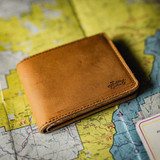
Pick up something like our bifold wallet and you'll notice the difference right away. It gives where it should, breaks in around your cards, and still holds itself together after plenty of pocket time.
Read the Label Closely
Fine print is where vague claims go to die. Brands that use full-grain leather usually say so clearly because it is worth saying. Labels like “real leather,” “genuine leather,” or just “leather” may tell you some type of leather is involved, but they don’t tell you whether the strongest surface of the hide is still there.
So read the product description like you’d read a used car listing from a guy named Stan who says “trust me” a little too early. Look for plain language, the exact words “full grain,” and enough detail so you know what you’re actually buying.
What Makes a Full-Grain Leather Wallet Worth the Investment
The answer is not one thing. The value comes from the hide, the way it’s built, and the kind of company your money ends up supporting.
The Hide
Good leather starts before the wallet ever gets cut. Full-grain leather matters because it gives you the part of the hide that was built to take weather, friction, and time. That doesn’t mean every full-grain wallet is automatically great, but it does mean the material has the right bones.
The Construction
The leather can be excellent and still get wasted by lazy construction. A wallet meant to last needs strong stitching, smart folding, and as few weak points as possible.
That’s why our wallets are built in our own factory using full-grain hides from reputable tanneries. Every cut, fold, stitch, or lining has to earn its place. The point is not to make a wallet complicated. The point is to make it useful for a very long time.
The Company Behind It
There’s also something to be said for knowing who made your wallet and what they stand for.
Through Love 41, our mission-driven brand, profits support work like child sponsorship, education, and community programs. That doesn’t make the leather stronger, but it does make the purchase mean a little more.
And if a company claims a wallet can go the distance, it should be willing to back that up. Saddleback’s full-grain leather wallets come with a 100 Year Warranty because they’re built for decades of real use.
In the end, a full-grain wallet is worth it when it is made to last, made honestly, and made by people who care what happens long after the sale.
The Long Game Is in the Grain
A wallet is a small purchase with a long job description. Hold the important stuff. Age without falling apart. Look better after real use, not worse. That is a lot to ask from a piece of leather, which is exactly why you need to choose the right one.
Full-grain leather is the material we trust for that job because it gets seasoned, not spent.
Ready to put your money in something worth carrying? See our collection of full-grain wallets today.
Posted by the Saddleback Team on 16th June 2026
Share

Posted by Dave Munson on 31st March 2022 Updated 2024
Sign up to stay updated on Saddleback Leather products, events, and stories.
The Saddleback Leather Newsletter is where you’ll get the latest news, first looks at new designs, and unprofessional and not funny stories delivered straight to your inbox.